-
There's No Single "Best" Wall System—There Are Three Different Projects
- Scenario A: New Construction or Major Renovation with High Traffic
- Scenario B: Renovation Over Existing Substrate with Mixed Conditions
- Scenario C: Spec-Driven Projects Where Performance Is Non-Negotiable
-
How to Figure Out Which Scenario You're In
There's No Single "Best" Wall System—There Are Three Different Projects
I'm a quality and brand compliance manager at a building materials distribution company. I review every panel order before it ships—roughly 400+ orders annually. In 2024 I rejected about 12% of first deliveries due to spec mismatches, color inconsistencies, or substrate issues that the vendor claimed were "within industry standard."
So when someone asks me "what's the cheapest option for wall panels in a commercial project," I honestly can't give them a straight answer. Because the right choice depends almost entirely on what kind of project you're running.
Most cost guides give you a single number—a cost-per-square-foot range—and call it a day. That's the kind of advice that sounds clean but falls apart the moment you actually try to budget for a real job. I've watched contractors lock in a unit price from a commercial wallpaper distributor, then blow past their budget because the adhesive wasn't included, or the walls needed three coats of primer, or the waste factor was 22% instead of the 10% they planned for.
What follows is how I'd walk a distributor or contractor through the decision. There are three main scenarios I see in the field, and each one points to a different solution.
Scenario A: New Construction or Major Renovation with High Traffic
What defines this scenario
You're finishing walls in a building where durability and cleanability actually matter: healthcare corridors, school hallways, commercial kitchens, veterinary clinics, food processing facilities, or any space where walls get hit, scrubbed, or splashed. The substrate is new drywall or has been brought back to a clean state. You have access to the wall before fixtures go in.
What I'd recommend and why
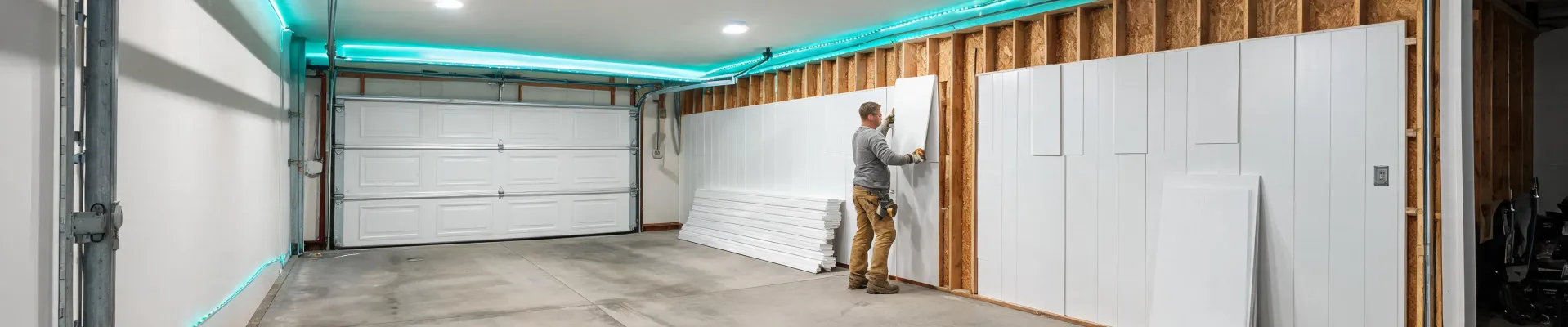
This is where PVC wall and ceiling panel systems like Trusscore earn their cost. Not because the material is cheaper per square foot—it usually isn't—but because the installed cost drops faster than almost any other finish.
- Labor: A two-person crew can install PVC panels over prepared substrate at roughly 2–3x the rate of commercial wallpaper. No adhesive cure time. No pattern matching. No waiting between coats of primer and finish.
- Waste factor: With panelized systems, waste is typically 5–8% versus 10–20% for wallpaper on complex walls.
- Maintenance lifecycle: Wallpaper in a hospital corridor gets replaced every 3–5 years in many facilities. PVC panels get wiped down. Over a 15-year horizon, the redo cycles alone can flip the math.
I had a project in early 2023 where a client was comparing bulk commercial wallpaper at roughly $0.85–$1.50 per square foot (material only) versus a PVC panel system at $2.20–$3.50 per square foot (material only). On paper, the wallpaper looked 60% cheaper. But the installed cost—after labor, adhesive, primer, and the projected two re-wallpaper cycles over ten years—came within 4% of the PVC system. And the PVC system didn't need to be re-done.
"It's tempting to think you can just compare unit prices from a wholesale cost guide and pick the lowest number. But identical specs from different vendors can result in wildly different installed costs—and that's before you factor in what happens five years down the road."
The counterintuitive part
People assume the cheaper material always wins on a tight budget. But when you're dealing with a 50,000-square-foot facility, the difference between "budget meets spec" and "budget doesn't meet spec" often comes down to whether you accounted for the true installed cost—not the line-item price from a wholesale distributor.
Scenario B: Renovation Over Existing Substrate with Mixed Conditions
What defines this scenario
The walls already exist. Some areas are smooth. Some have old wallpaper, paint, or minor damage. You're working around fixtures, and you can't always bring everything back to bare, clean drywall. This is common in office fit-outs, retail refreshes, and hotel renovations where guest rooms are done in phases.
What I'd recommend and why
Here's where I'd actually push back on the PVC panel recommendation in many cases. Not because the product is wrong—but because the substrate prep cost can eat the entire advantage.
PVC panels need a reasonably flat, clean, dry surface. If you're going over a wall with multiple layers of old wallpaper, patched drywall, and inconsistent texture, you're looking at significant prep time. In some cases, you'll spend more on leveling and patching than the panels themselves.
In this scenario, I'd compare three options:
- Commercial wallpaper over liner: A heavier-weight commercial wallpaper (Type II, 20–30 oz) applied over a liner can bridge small imperfections. Material cost from a commercial wallpaper distributor for Type II vinyl is typically in the $1.10–$2.00 per square foot range. This is often the fastest path for large, repetitive spaces like hotel corridors.
- Decorative wall panels (MDF or composite core): These can go over existing walls in some systems, but pay attention to thickness and how they handle transitions at door frames and outlets. Wholesale cost for decorative panels runs roughly $2.50–$6.00 per square foot depending on finish and core. They look premium and install relatively fast, but they're not typically rated for wet or high-impact areas.
- PVC panels with furring strips: If you can accept losing ½"–1" of room dimension, you can install PVC panels on furring strips over imperfect walls without full resurfacing. This is a middle path that works well in utility spaces, back-of-house corridors, and restrooms.
I assumed for years that "panel systems always win on speed." Didn't verify that assumption across every substrate condition. Turned out on mixed-condition walls, a good wallpaper crew can actually finish faster if the walls are already in decent shape. The key phrase is "in decent shape."
A note on color and batch consistency
Whatever you pick in a renovation, verify batch consistency before you commit. I've seen commercial wallpaper from two production runs that looked identical in the sample book but had a visible tone shift on the wall—one lot ran warm, the other ran cool. A Delta E of 2–4 is noticeable to a trained eye. Above 4, most people can see it.
The same applies to PVC panels and decorative panels. For brand-critical colors, the industry standard tolerance is Delta E < 2. Ask your vendor for batch numbers upfront. If they can't provide them before the order ships, that tells you something about their process control.
Scenario C: Spec-Driven Projects Where Performance Is Non-Negotiable
What defines this scenario
You're working on a project with explicit specifications: fire rating, washability, impact resistance, moisture resistance, or chemical resistance requirements. This might be a hospital, a laboratory, a commercial kitchen, a school, or a government facility. The spec is not negotiable, and your product choice is largely determined before you even open the cost sheet.
What I'd recommend and why
In this scenario, the cost guide becomes almost irrelevant until you've confirmed compliance. The order of operations matters:
- Confirm the spec. What fire rating is required? What washability standard? Is there a moisture exposure rating? Does the surface need to meet a specific cleanability protocol?
- Filter products by compliance. PVC panel systems generally perform well on moisture resistance and cleanability—but verify the specific product's certifications. Commercial wallpaper varies widely; Type II vinyls are more durable than paper-backed options but may not meet all fire ratings without specific documentation.
- Then compare cost. Only after the compliant set is identified does cost comparison make sense.
I've seen contractors skip step one and two, find a great price, order material, and then discover during submittal review that the product doesn't meet the spec. That's a redo. I had one project where the material had to be returned after delivery—$18,000 in product and freight costs, plus a two-week delay. The vendor claimed the product "met industry standard." The project spec required something specific. "Industry standard" wasn't the spec.
Now every contract we handle includes a submittal checklist that forces the conversation before the PO goes out. It's five minutes of extra work on the front end. It's saved us from at least three redos I can remember.
Where PVC systems fit in spec-driven work
PVC wall and ceiling panels—including Trusscore panels—tend to do well in healthcare, food service, and institutional projects because of their moisture resistance and cleanability profile. They don't need painting, they don't peel like wallpaper can in humid environments, and they can be wiped down with commercial cleaners. That said, verify the specific certifications for your project. Don't assume. The product family performing well in one facility doesn't automatically mean every SKU meets every spec.
How to Figure Out Which Scenario You're In
Answer these four questions before you request a single quote:
- What's the substrate condition? New or clean drywall → Scenario A. Mixed or questionable → Scenario B. Doesn't matter because the spec controls → Scenario C.
- What's the expected lifespan before re-finish? 3–5 years → wallpaper may be fine. 10+ years → panel systems likely win on total cost.
- Is there a spec with hard performance requirements? If yes, you're in Scenario C. Filter by compliance first, cost second.
- Can you access the walls without significant prep or protection work? If not, factor prep cost heavily into your comparison—it often flips the decision.
Honestly, most projects I see fall into A or C. Scenario B is the messiest to price because variability is high—but it's also where good upfront analysis saves the most money. The mistake I see most often is treating a Scenario B project like a Scenario A project: assuming the walls are ready when they're not, and then absorbing the prep cost as a change order.
Bottom line: there's no universal cheap option. There's only the option that's cheapest for your specific combination of substrate, spec, lifespan, and labor reality. Get those four variables right, and the cost comparison almost solves itself.
And keep a checklist. Five minutes of verification beats five days of correction—every time.
Note on pricing: All cost ranges in this article are based on 2025–2026 wholesale market observations across multiple vendors and regions. Material costs fluctuate with resin pricing, shipping, and order volume. Treat these as planning ranges, not quotes.