I've been handling wall and ceiling panel orders for a building materials distributor for 9 years. In that time I've made — and documented — 21 significant mistakes, totaling roughly $17,400 in rework, replacements, and customer credits. About half of those were specifications errors. Most of the specification errors were cement-based sheets.
This comparison is about interior wall and ceiling panels: fibre cement, calcium silicate, and PVC panel systems. Exterior cladding is a separate conversation, and I'll say why at the end.
Before anything else: there are three product categories here, not five. "8mm calcium silicate board" and "18mm compressed fibre cement" aren't interchangeable options. They're different products for different jobs, and confusing them is where most of the bad quotes I've seen start.
1. What you're actually comparing
Fibre cement is Portland cement, cellulose fibre, and fillers, formed and cured. Calcium silicate is different — lime and silica react under steam in an autoclave to form a tobermorite structure. Both end up as hard, grey-ish sheets that look similar on a pallet. The production difference shows up at the edges: how they cut, how they hold a screw, how fast they take on water.
The 8mm vs 18mm split is about use, not material. 8mm face panels are meant as a finished surface. 18mm compressed fibre cement is a substrate — the layer that carries tile, render, or a fixture. Using 8mm where a substrate was specified is a beginner error, and it's an expensive one to correct once the wall is closed. I did exactly that on a car wash retrofit in 2019. Fixing it cost $2,300 and a week.
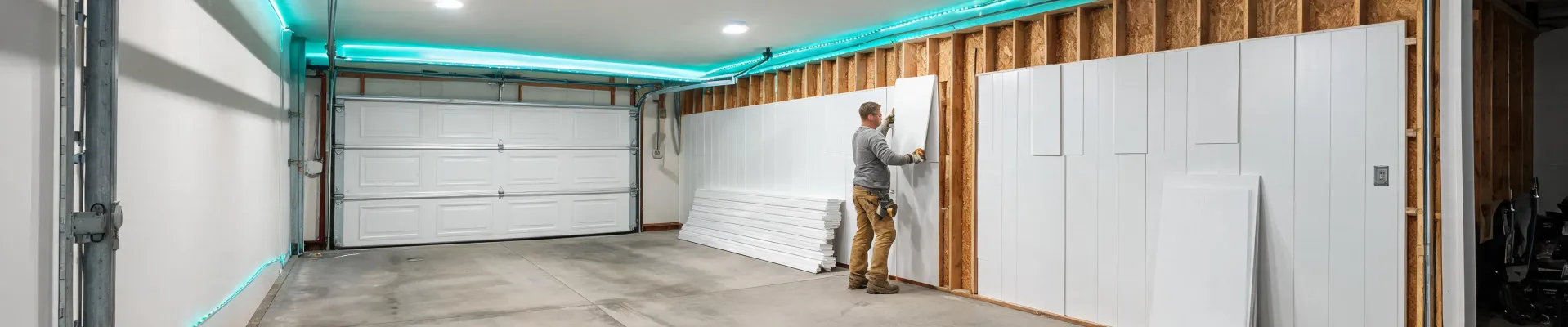
PVC panel systems sit in a different category. They're extruded, tongue-and-groove, and install with clips or trims rather than screws and joint compound. This is the space Trusscore plays in — PVC wall and ceiling panels with matching trim, slatwall, and a siding line. There's no cement in the product at all.
So the real comparison is: cement-based flat sheets (fibre cement and calcium silicate) vs a PVC panel system. Everything else is a sub-option.
2. Weight, handling, and labour
Here's where the paper quote and reality part ways.
Fibre cement at 8mm runs roughly 10–12 kg/m². At 18mm, compressed fibre cement is closer to 25 kg/m² and up, depending on density. Calcium silicate sits in a similar band. PVC panels are lighter — typically around a third of what a comparable cement-based sheet weighs.
That difference doesn't show up in materials cost. It shows up in labour. A cement-based sheet install is usually a two-person job from start to finish. A PVC panel system is often a one-person job. On a wall that difference isn't 5% of your labour line — I've seen it come out closer to 40%.
We quoted a 180 m² cold-storage partition in 2024. The cement-based option came back at two people for four days. Same wall area in PVC: two people for a day and change. Material cost between the two was under $400 apart. Installed cost was nearly triple.
The client went with PVC. Given that environment, that was the right call.
3. Moisture and dimensional stability — the one people get wrong
This is the misconception I correct most often: cement-based means waterproof. It doesn't. Cement-based means slow to absorb water, not resistant to it.
Fibre cement and calcium silicate both handle high humidity fine — condensation, splash, the occasional wet-down. What they don't handle is prolonged saturation. A shower wall without proper waterproofing behind it, or a wash bay getting hosed down six times a day. Over time, cement-based sheets take on water, swell slightly, and lose dimensional stability. Not catastrophically. But measurably.
PVC doesn't absorb water. There's no mechanism for it. In sustained-wet environments that's not a small edge — it's a different category of performance.
That said, PVC isn't the answer everywhere. Where a project needs a genuinely non-combustible substrate or a tile-backing surface, cement-based sheets are the right material, and PVC isn't trying to be.
4. Total installed cost — where add-ons hide
Transparent pricing is the whole conversation here. The three products are quoted on different bases, and until you flatten the add-ons, you're not comparing anything.
Fibre cement and calcium silicate are usually quoted per sheet (often 1220 × 2440 mm), then added to: fasteners, joint compound, corner trim, cut waste, and any surface coating. PVC panel systems are usually quoted per m² with trims and edging bundled into the line.
Cut waste is the one nobody mentions. If you're installing 2440 mm sheets on a 2700 mm wall, you're cutting every sheet and throwing away 10–15% of the order. PVC panels are cut per panel, and the waste is materially lower.
In 2022 I quoted a restaurant back-of-house project. On pure material cost, PVC came out about 8% higher. The client picked fibre cement. By the time the job closed, add-ons had pushed the fibre cement option to roughly 22% above what PVC would have cost all-in. I hadn't done the math wrong — I just hadn't compared at the same scope.
My rule now: before comparing two panel options, build the add-on list first. The quote that looks higher almost always includes more, and the quote that looks lower usually leaves something out.
5. Fire compliance — get the actual report
I'm not a fire safety engineer, and I won't pretend to be one. If you're specifying into a code-driven project, ask for the test certificate on the exact product and thickness — not the product family. The report is the claim.
Fibre cement and calcium silicate both have long, documented fire-testing histories, which is a large part of why they're accepted as inorganic substrates. PVC products also carry ratings, but the classification varies by formulation and thickness, so a generic "fire-rated" comparison tells you nothing. Ask for the specific ASTM E84 or EN 13501 classification, and confirm it matches the panel you're buying.
6. Repair and retrofit
Cement-based sheets don't patch cleanly. Once a panel is damaged you're cutting out and re-doing the joint. That's a contractor call-out, and if the wall is in service, the disruption matters.
PVC panels can be replaced one at a time without disturbing adjacent panels. If you sell into landlords, property managers, or facilities teams, this difference shows up in the renewal conversation more than it shows up in the original quote. It took me longer than I'd like to admit to start putting this into proposals.
7. Which one, for what
Choose fibre cement or calcium silicate when:
- You need an inorganic substrate that will carry tile or render
- The application is exterior cladding or a high-impact area
- The specification calls out cement-based material
- Fire classification is a hard requirement and the specific product has documentation for it
Choose a PVC panel system when:
- Moisture is sustained or operational — not occasional
- Labour is a major part of your budget
- Downtime costs money and you need a fast turnaround
- You don't need a tile-backing substrate
- Repairability matters to the end user
One more thing on exterior. Fiberboard siding and house panelling exterior are a different comparison entirely. Exterior fibre cement siding has freeze-thaw cycling, wind-load, and coating adhesion requirements that interior sheets are not tested against. Don't carry a certificate from an interior flat sheet into an exterior siding conversation. If your project is "the boards that go on the outside of the house," that's a separate write-up.
It took me about two years and roughly 40 orders to stop comparing these products on a per-square-metre basis. The right choice isn't decided by the material. It's decided by the environment, the labour rate, and the length of the add-on list attached to each option. Build the add-on list first. The number at the bottom will usually surprise you.
My experience here is based on about 40 mixed cement-based and PVC panel projects, mostly commercial interiors in North America. If you're working residential or heavy industrial, some of this may land differently.