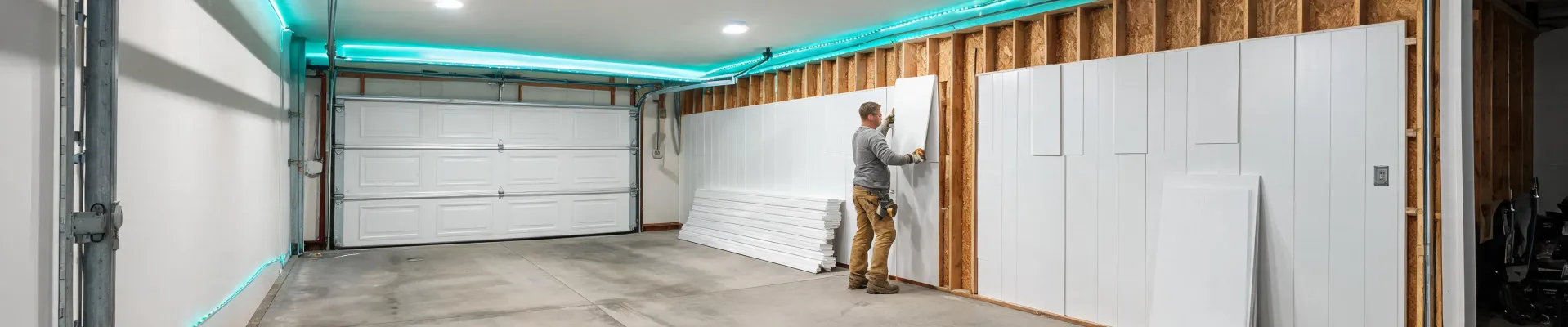
I’m going to say something that might make some of my supply-chain colleagues uncomfortable: a small order for Trusscore panels is not a favor to you. It’s a legitimate business need — and it deserves the same seriousness as a 10,000-square-foot order. That may not be how the market behaves, but it’s how it should behave.
In my role as an expediting manager at a building-materials distributor, I’ve handled 200+ rush orders in seven years. Some were as small as fifty panels; some were a full theater fit-out. The small ones usually come from contractors who are doing a retail fit-out, or a landlord repairing a rental unit, or an electrician who needs to hide a utility wall without tearing up the building. They’re not “lesser” projects. They’re often the most deadline-critical, because there’s no margin for error.
In March 2024, a contractor called at 3 p.m. needing 80 linear feet of wall panels for a store opening Monday morning. He didn’t ask about price; he said, ‘If you can get panels here by Saturday, you’ll save our opening.’ Normal turnaround is four or five business days. We found a way to pull the order from a local distributor, paid $190 extra for a Saturday courier (on top of the $640 panel cost), and the panels were ready Saturday evening. The client’s alternative was missing the opening and a $12,000 penalty clause. That’s the kind of urgency we manage for both big and small accounts.
Why Small Orders Get Bad Service
Honestly, I get why some large suppliers deprioritize small orders. Fulfillment lines are calibrated for bulk, sales incentives are tied to volume, and a one-pallet order doesn't move their metrics. But that attitude creates a vacuum. It leaves small contractors scrambling, which is exactly why we built a separate lane for them — and why we’ve seen those accounts come back with bigger projects later.
Maybe you think “small order” means a homeowner buying a few panels. I mean trade pros. A kitchen-and-bath installer covering dated tile. A commercial landlord fitting out a small office. A facilities manager replacing a damaged board in a high-traffic corridor. Their orders might be small in dollars, but they are specific and professional. They ask for delivery dates, they understand lead times, and they know what they need. Give them a real answer and they'll become your advocate.
The Hidden Cost of Chasing “Wholesale” Prices Too Early
Now let's talk money, because I know that's why many people Google “trusscore panels for sale” or “pvc wall panels wholesale” in the first place. We all want to save money. But I have a personal regret that I still kick myself over.
In 2023, we were helping a new client source decorative wall panels wholesale for a small coffee-shop chain. The client was under pressure from their investors, and I let myself be talked into a private-label factory that was undercutting the branded panel we normally spec by about 18%. The numbers looked good on paper. My gut, though, noticed their sample had a subtle color mismatch, and their emails took two days to get a response. But I pushed the gut feeling aside. The spreadsheet said “savings.”
Three weeks later, half the order arrived with surface scratches and color inconsistency. The client had to pull out 200 square feet of installed paneling, reorder the branded product, and pay for expedited freight. The initial savings on the purchase was about $340. The cost of reorder, labor, and lost schedule confidence was north of $4,200. I still kick myself for not pushing for a pre-production sample review. If I’d done that, we would have caught the QC problems before the panels left the factory.
This is not an argument against private label as a concept. It’s an argument against choosing a supplier based on price alone, especially for a small order where there is no safety stock to fall back on. The lowest price per square foot doesn’t matter if the delivery date slips or the panel dimensions aren’t within tolerance.
What Actually Matters in a PVC Wall Panel Supplier
So when you’re buying Trusscore panels — or any PVC wall panels for commercial use — what should you actually check?
- Spec transparency. Ask for third-party test reports. In North America, the relevant standards for rigid PVC panels include ASTM D1784 for compound quality and ASTM E84 for surface burning characteristics. If a supplier can’t share them, walk away. And verify them yourself before you trust them.
- Inventory depth. It’s great if a supplier stocks multiple lengths and profile accessories. When you need a replacement panel in three days, you don’t have time for a custom extrusion run.
- Pricing clarity. There’s nothing wrong with a minimum order quantity — it’s better to know it upfront. But a decent supplier will also be explicit about volume discounts, freight terms, and restocking fees. Hidden surcharges are the real enemy.
Also, don’t overlook the people. If a supplier doesn’t respond to a small inquiry within 24 hours, imagine what they’ll do when you have an emergency. The checklist matters, but so does the relationship.
OEM vs. Private Label: A Plain-English Answer
The phrase “pvc wall panels oem vs private label” gets searched a lot. Here’s the plain-English difference: an OEM manufacturer makes panels to another company’s design; private label is when you take a generic panel and put your own brand on it. For a distributor who wants to sell under their own brand, private label can work — if the factory has solid QC and you do your due diligence. For a contractor who needs a specific product spec, I’d rather buy a branded panel with known provenance and a clear warranty path. The OEM route is neither automatically good nor bad; it’s a supply-chain decision, not a bargain-hunting strategy for an urgent order.
The Question Worth Asking Before You Order
Here’s where I know some readers might push back. “Small orders are expensive to handle. Simple economics.” Fair enough. I’m not saying a $500 order deserves the same discount as a $50,000 order. I’m saying the service level and respect level can’t be scaled down to zero.
The real question for any buyer, large or small, is: “Do I have a supplier who will respond when it matters?” Not “which quote is lowest.” Because a wall panel that doesn’t arrive on time, or doesn’t meet code, isn’t a wall panel at all — it’s a liability.
Last quarter, we processed 47 rush orders with a 95% on-time record. Of those, 26 were below $1,500 in value. Four of those small orders have already become repeat accounts with cumulative orders above $30,000. That’s not a charity story; it’s a growth story.
Final Word: Small Orders Are Doorways
So here is my view, restated without apology: small orders are not a nuisance to tolerate. They’re a door. The suppliers who understand that will win the next generation of contractors. The ones who treat low-volume orders as an inconvenience are leaving money on the table — and, more importantly, leaving clients stranded on the job site.
If you’re looking for a PVC wall panel supplier for a small project, hold out for the one who asks about your deadline, verifies specs, and treats your order like it matters. Because it does. And if you’re a supplier who read this and rolled your eyes, I’d encourage you to add up the lifetime value of the last five “small” orders you considered ignoring. You might be surprised — I know I was.