I'm the office administrator for a 400-person professional services firm. I manage all the facility-related purchasing—somewhere around $450,000 a year across eight or so active vendors—and I report to both operations and finance. In 2024, our company consolidated two offices into a new headquarters and refreshed a third location. That put me in charge of wall and ceiling finishes for roughly 40,000 square feet (I'd have to check the architect's drawing for the exact number). My bluntest takeaway from the project: what to look for in a wall panels supplier is not the prettiest sample or the trendiest material—it's accurate specs, realistic lead times, and paperwork that can survive contact with a contractor, a building inspector, and an accountant. The panel itself is only half the product.
I should also say I didn't start with that opinion. In 2020, I chased a few-thousand-dollar price break from a brand-new vendor. The product arrived on time, but the vendor couldn't produce a proper invoice—just a handwritten receipt—and finance rejected the entire expense. The $2,400 bill came out of my department's budget. Now I check invoicing before I place anything larger than a sample order. It's not the lesson I expected to learn, but it's the one that stuck.
What I look for in a wall panels supplier
My checklist is the same whether I'm ordering acoustic panels, Trusscore panels, or commercial wallpaper. The materials are different, but the risk is the same: you're buying a promise about how something performs, and you need that promise on paper.
First, I ask for the full spec sheet, not the sales brochure. I want the technical data sheet that lists dimensions, material composition, surface finish, weights, and any test standards the product claims to meet. If a supplier can't produce one, I assume they've never been asked and that the building inspector will eventually ask next. Environmental claims deserve the same skepticism. In the U.S., the FTC Green Guides lay out how terms like 'recyclable' or 'recycled content' should be substantiated. If a supplier says their panel is 'green' but can't give you a percentage or a source, that's a marketing sentence, not a spec. Having the data doesn't guarantee a smooth project. Not having it guarantees a stressful one.
Second, I ask about inventory and lead times. Is the item stocked or made to order? What is the actual lead time, not the catalog lead time? During the 2024 renovation, one supplier quoted two weeks for a wall covering; that date became nine weeks after our order. The material sat on the critical path for two rooms, and every surrounding trade had to be rescheduled. I would have chosen differently if the supplier had been straight with me.
Third, I ask how products are packaged and shipped. Long rigid panels are vulnerable in transit. We had a bundle of panels arrive with crushed corners because the freight company stacked bins on top of them. The driver encouraged me to sign quickly; I checked anyway and took photos. Ask suppliers what their typical damage rate looks like. If they don't know, that's an answer too.
If you're buying through a distributor, ask them the same questions. A distributor can't fix a manufacturer's missing test report, but a good one can tell you how a product behaves in the field before you commit. We buy most project materials through distribution, and I've learned to use their warehouse staff as a reference source. They see the returns.
Fourth, I ask for references on projects that are at least two years old. A brand-new showroom looks great under good lighting. A two-year-old corridor in a working building shows what a panel looks like after vacuums, rolling chairs, and janitorial carts. A supplier who can't produce one usable reference is a red flag, no matter how beautiful their sample kit is.
Match the material to the room, not the other way around
Once the supplier list passed those checks, I got to do the fun part: choose materials. I had to correct my own assumptions here, so let me walk through the three wall products we actually used.
We used commercial wallpaper in low-traffic conference rooms and a few niches near the executive offices. If you're asking what to look for in a commercial wallpaper supplier, start with pattern consistency and removal behavior. Pattern lots shift between production runs, and on a large wall even a small dye difference shows at the seam. You should also ask how the wallpaper comes off years later. In leased space, the landlord may require you to return walls to bare drywall, and some vinyl wallcoverings peel clean while others put up a fight. That question should be asked before installation, not at the end of the lease.
Acoustic wall panels are a different category, and they nearly fooled me. We needed them for phone rooms and focus rooms, and the first product I liked had an impressive NRC number on the marketing page. But an acoustic panel absorbs sound; it doesn't block sound. If your real problem is conversation leaking through a partition, absorption panels on one wall won't fix the path over the ceiling or under the door. Put another way, I almost bought acoustic panels to solve a privacy problem they couldn't solve. The failure wouldn't have shown up until after the invoice was paid.
And one note for distributors and dealers reading this: acoustic wall panels are frequently private labeled. If you're considering an acoustic wall panels private label arrangement, that's not a red flag by itself. Just ask for the original lab reports and make sure you can issue them with your name on them. The panel doesn't perform differently because your logo is on the carton. The accountability, however, shifts to you.
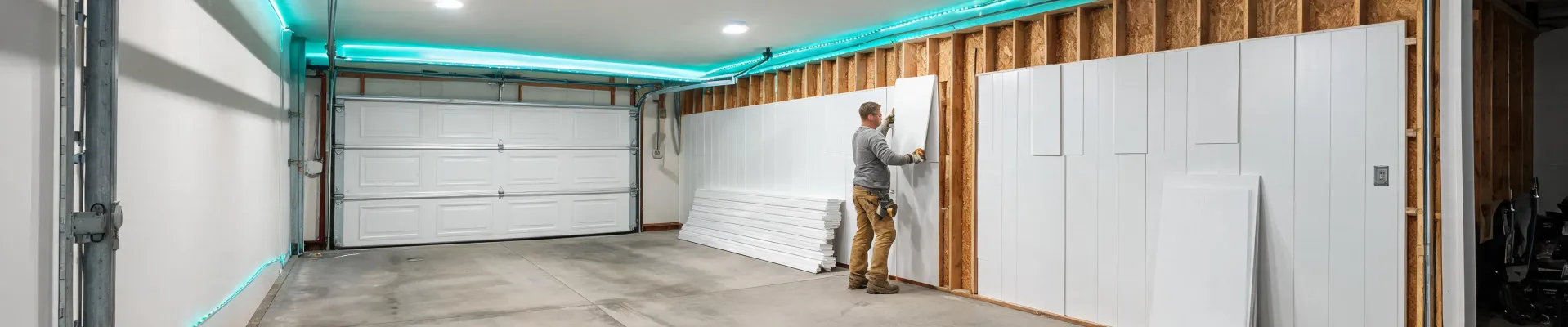
The material I initially dismissed was rigid PVC. We ended up installing Trusscore PVC wall and ceiling panels in the break room, a long internal corridor, and the print and utility room. Before this project, I heard 'PVC wall panel' and pictured a cheap basement product, so I moved on quickly. What I underrated was the system thinking behind Trusscore panels. The panels, trim, corners, and edge accessories are designed to work as one system. That sounds like a marketing sentence—I know. On site, it meant the installers didn't improvise transitions around doors and corners, and the finishing details took hours instead of days.
The genuinely surprising part came in the cost comparison. The material price of the Trusscore PVC system wasn't always lower than commercial wallpaper. But the installed cost was better, because the substrate needed less prep and the crew moved faster. When you budget a renovation, compare cost per square foot installed, not material price alone. That single number saved us from a bad decision.
Also, for the record: no wall panel is maintenance-free. PVC panels are easy to wipe down and won't need repainting the way drywall does, but they can still get scratched or gouged by a carelessly moved cabinet. If a supplier ever tells you a product will never need attention, I'd treat that as a red flag, not a benefit.
When this approach falls apart
I can only speak to my own context: U.S. domestic projects, normal office humidity, occupied buildings, and a fast but not insane renovation schedule. If you're dealing with a commercial kitchen that gets pressure-washed, a coastal building with salt air, or a space where the lease requires specific acoustic isolation, the material math changes. Ask manufacturers and distributors to show you installations in your conditions, not just in an office like mine.
This is also where a good wall panels supplier earns their keep. The supplier who gave us straight answers during bidding was the same one who produced the right documentation at the end. At final inspection, the building department asked for product data on the finishes we installed. I had a binder ready, including the Trusscore paperwork, only because I'd made documentation a condition of purchase. It felt like overkill while ordering. It stopped feeling like overkill the moment the inspector opened the binder and nodded.
The whole experience taught me that good walls are boring. They don't make people gasp, and they shouldn't. The walls that give you no stories are the sign that the supplier did their job. That's exactly what I'm looking for.