It was 2:37 on a Tuesday afternoon in March 2025 when my phone rang. The caller ID said "Costa's Deli & Market," and I almost didn't pick up.
I'm glad I did.
Sixteen hours later, I was standing in a half-renovated commercial kitchen with a tape measure, a stack of spec sheets, and a problem that didn't have an obvious answer.
The call that started it
For context, I coordinate commercial finish installations for a mid-sized building supply distributor in the Northeast. We're not the biggest house on the block, but we've carved out a niche: we take the jobs other suppliers won't touch. Small runs. Tight deadlines. Custom requests.
In my role, I've handled roughly 200 rush orders over the last six years, including same-day turnarounds for food service and retail clients. I've learned to recognize the tone of voice people use when they're past panicked and moving into desperate. The guy from Costa's had that tone.
"We open Friday," he said. "The health inspector comes Thursday at 10 AM. Our walls... they're not going to pass. I need something I can put up today or tomorrow. My general contractor walked off the job this morning."
Now, I should pause here and tell you something important: I'm not a materials engineer. I'm not a spec writer. I'm the guy who figures out how to get the right panels in front of the right people before a deadline turns into a disaster. My experience is based on maybe 200 mid-range commercial orders. If you're working on luxury residential or heavy industrial projects, some of what I'm about to say might not apply to you.
But if you've ever had a client call with 36 hours of runway and a growing hole in their budget, this story is going to feel familiar.
The problem wasn't what I expected
Costa's needed to replace the wall surfaces in a 2,400-square-foot kitchen prep area and back-of-house corridor. The old tile had been installed in the 1980s. It was stained, chipping, and frankly, not something any health department would sign off on.
The original plan had been commercial tile. Then the GC quit. Then the tile supplier said their lead time was 10 business days. Then someone Googled "PVC wall panels" and found Trusscore, and my phone rang.
Here's where I need to be honest about my own ignorance: I'd heard the name Trusscore, but I hadn't specified their products before. I knew they made PVC wall and ceiling panels. I knew the panels were supposed to be easier to install than tile or FRP. Beyond that, I was working from the same information the client had — which was a website and a prayer.
The first thing I did was call my rep. Let's call him Dave — not his real name, but he's earned the anonymity. I asked him a question I've asked a hundred times before:
"What's your lead time on a small order? Like, 60 panels worth."
I said "as soon as possible." What I meant was "by tomorrow morning, ideally." What Dave heard was "whenever it ships." We discovered the gap three hours later when I called back looking for a tracking number and he said, cheerfully, that the order would be ready to ship in "five to seven business days."
That's a communication failure I've made more times than I'd like to admit. We were using the same words but meaning different things. I've since learned to say "I need this physically on a truck by 6 AM tomorrow. Can you do that?" — but at that moment, I was staring down a health inspector's visit with no panels in sight.
Why the specs actually mattered
Here's the thing about PVC wall panels that I didn't fully appreciate until I had to make a real decision under pressure: not all panels are the same, and the specification guide isn't just marketing paperwork.
While I was on the phone with Dave, he asked me three questions I didn't have good answers to:
- What's the wall condition behind the panels — studs, drywall, or old tile?
- Are we talking interior or exterior walls?
- Does the client need acoustic performance in any of the spaces?
I knew the answers to none of these. I'd been so focused on the deadline that I'd skipped the part where I actually verified the installation conditions. Classic pitfall. The third time you make a mistake like this, you start building checklists. I should have had one already.
So I drove to the site. Costa's was a wreck — construction dust everywhere, the old tile half-removed, exposed studs in some areas and crumbling drywall in others. But walking through it, I realized something: the Trusscore system was actually well-suited to exactly this kind of mess.
The panels are designed to be mounted over existing surfaces in many cases. The trim pieces cover the seams and edges. And because they're PVC, they handle moisture and cleaning chemicals better than painted drywall ever could.
But here's the part that matters for anyone considering Trusscore or any PVC wall panel system: you still need to know what you're looking at. The specs are published on the manufacturer's website, and they're not hiding anything. Panel thickness. Width. Length. Impact resistance. Fire ratings. Acoustic performance if you order their specialty panels. But a spec sheet is only useful if you read it before you're in a panic.
If you're a distributor looking to expand your offering, it's also worth knowing that Trusscore supports private label programs. That matters if you're exploring acoustic wall panels private label or thinking about building a decorative wall panels specification guide under your own brand. The product documentation gives you a solid foundation for that.
The small-order moment
That's when the order got awkward. Costa's needed roughly $2,300 worth of panels and trim. For a distributor that regularly ships $20,000+ orders, this wasn't a big deal. But I've been in this industry long enough to know that some suppliers treat small orders like a nuisance. They'll take your money, but they won't rush for you.
I don't work that way. And in that moment, the reason became personal.
Back in 2021, I was running a tiny e-commerce business. I needed 12 custom-cut panels for a prototype booth. Three different vendors ghosted me after I told them my order size. The fourth — a smaller supplier — treated my $400 order like I was their most important customer. They sent samples. They answered my stupid questions. They delivered on time.
Today, that same supplier gets my $20,000 orders. Small doesn't mean unimportant — it means potential.
Costa's wasn't a $20,000 client. They were a family deli that had poured their savings into a renovation and gotten burned by a contractor who walked. They needed help, and they needed it fast. There was no world where I was going to tell them "sorry, your order is too small for us to expedite."
How we made it happen
Dave and I worked out a plan. Trusscore panels ship in lengths up to 16 feet, but they also cut them down to size in many cases. For Costa's, we ordered 8-foot panels — easier to transport, easier to handle in a tight commercial kitchen, and they matched the wall heights perfectly with minimal waste.
We did pay a rush fee. I won't pretend we didn't. It was $480 on top of the $2,300 base cost, and it touched off a conversation about my company's approval policy for emergency freight. But the alternative — waiting a week for standard ground shipping — wasn't an option. The health inspector was coming in 36 hours.
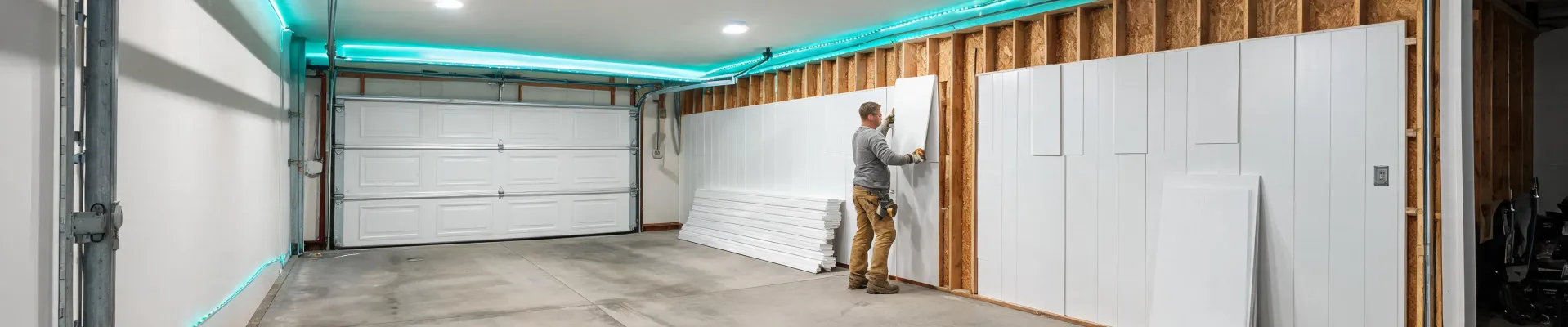
The panels arrived at 7:15 AM the next day. My installation crew (two guys, plus me with a drill and a lot of coffee) worked through the day. The Trusscore installation process is straightforward: cut the panels to width, attach the starter track, slide the panels in, cover the seams with trim. My guys had never installed it before, but after about an hour they had the rhythm down.
I'll be honest: the first panel was the hardest. We cut it 3/8 of an inch too wide and had to recut. After that, it went smoothly. By 4 PM, the kitchen prep area looked like a completely different space. White, clean, wipeable surfaces. No grout lines to scrub. No tile to chip. The crew finished the corridor by 8 PM, and we walked out exhausted but relieved.
The result
The health inspector passed them the next morning. No violations. Costa's opened Friday as planned.
A week later, the owner called me again. Not with a problem — to order panels for the front-of-house dining area. They'd seen how the kitchen turned out and decided to finish the whole restaurant. That order was four times the size of the first one.
I'm not telling this story to brag. I'm telling it because there are real lessons buried in it.
What I'd do differently
First: read the specification guide before you need it. The Trusscore spec materials tell you everything — panel dimensions, installation requirements, accessories, care instructions. If I'd reviewed them when I first heard the brand name instead of three hours before ordering, I would've saved myself a stressful afternoon.
The key specs to look for in any PVC wall panel system are:
- Panel thickness and impact rating — do they meet the demands of the space?
- Surface finish — matte, gloss, textured? Does it camouflage scuffs?
- Fire and smoke ratings — commercial kitchens often require specific classifications.
- Acoustic performance — if you need sound control, standard panels won't double as acoustic wall panels.
- Accessory compatibility — trim, corners, and fasteners are part of the system, not an afterthought.
Second: small orders are a test, and the test matters. I remember every vendor who treated my early orders with respect. I remember the ones who didn't, too. A customer who starts small and gets treated well is a customer for life. Costa's went from a $2,300 order to nearly $10,000 in follow-on business within three months.
Third: prove the deadline in writing. My initial call with Dave should have included the words "I need this by 6 AM tomorrow, is that possible?" Instead, I said "as soon as possible" and let him fill in the blank. That's on me. Now, I put deadlines in writing on every order. No ambiguity.
Fourth: ask about the install conditions before you order materials. We got lucky that the Trusscore system was flexible enough for the mixed conditions at Costa's. If the walls had been in worse shape, we would have needed a different approach. Knowing what you're mounting to is half the specification battle.
Stuff I still don't know
Honestly, I've never fully understood why some suppliers are willing to lose a customer over a small order. The cost of picking up a phone and answering a question is pennies. The cost of making that customer feel ignored is the entire lifetime value of that account.
I'm also not going to pretend I know how Trusscore performs in every scenario. My experience is based on a handful of commercial and light-industrial installations, mostly in food service and retail. If you're working on a project with unusual structural loads or extreme environments, talk to a qualified engineer and verify the specifications against your requirements. Don't take my word for it — take the manufacturer's published data. Pricing I've mentioned here is from March 2025 quotes; verify current rates, since they change.
The bottom line
PVC wall panels aren't the right answer for every project. But they're a legitimate, code-friendly, installable solution for a lot of commercial spaces, especially when time is short and the walls need to be cleanable.
And if you're a small business owner with a small order and a big deadline — find a supplier who treats your order like it matters. There are people out there who will. That's a lesson that works whether you're buying panels for a restaurant, cabinets for a clinic, or samples for a prototype.
As for Trusscore? I've since specified their panels on four more projects. Not because they're the cheapest option — they're not. Because the system is well-documented, the accessories are available, and the people I've dealt with answer the phone when it matters.
That last one counts for a lot in my book.