The Sign-Off Felt Good. The Installation Didn't.
In April 2026, I signed a purchase order for 62 Trusscore panels. The math felt bulletproof. Then the lead installer called from the job site on a Tuesday morning and said, “We're six panels short.” I ran the numbers again. He was right. Sixty-two panels worked on paper. It didn't work on the walls.
I've been doing light-commercial renovations for 11 years, and this was one of those mistakes I'd hate to admit to a client. The worst part? I'd called the distributor before placing the PO and asked, “Can you confirm 62 panels cover 2,480 square feet?” The rep said yes. We were both right. We just missed the same thing. Neither of us asked about waste factor, openings, or offcuts. We were using the same numbers but not the same question.
This isn't a dramatic train wreck. It's a quiet, forehead-slap mistake that cost us $345.80 plus a two-day schedule headache. I'm writing it down because I'd rather have another contractor learn from it than repeat it.
Why We Ended Up With Trusscore Panels
The project was a 3,400-square-foot dental office. The interior designer's first concept used bulk commercial wallpaper in the corridors and reception. It looked sharp in the renderings. But in a space where staff wipe surfaces with hospital-grade disinfectant, wallpaper seams become a weak point. Hand sanitizer and bleach spray can break down adhesive over time. We needed a wall that could take a scrub-down and still look clean.
The client also asked about acoustic wall panels wholesale, because they wanted to reduce noise between exam rooms. We got two distributor quotes in March 2026: one-inch felt acoustic panels were running about $2.80 to $3.30 per square foot in our region, before clips and installation. That felt like a heavy line item for walls that still had to survive medical-grade cleaning. If you're assembling an acoustic wall panels wholesale cost guide for your own bid, those numbers are a useful starting point, but prices vary by market and lead time.
The designer then pointed us toward Trusscore. The wall and ceiling panels are PVC, with a smooth surface that's easy to clean. If you're searching for “trusscore” or “trusscore panels,” you'll see pricing quoted per square foot, plus trim and fasteners. Our wholesale panel quote came to about $1.70 per square foot for that order. With trim, material cost landed around $2.20 per square foot installed—meaningfully below the acoustic panel route. We still handled sound with insulation in the wall cavity; the surface itself was chosen for durability and washability.
Before ordering, we checked the decorative wall panels specifications. The spec called for a Class A surface-burning characteristic, so we checked the product documentation for an ASTM E84 rating. We also looked for material standards commonly used with rigid PVC building products, such as ASTM D4216. If you're submitting Trusscore as an alternate to another panel system, having those references in the submittal makes the review a lot smoother.
I Forgot the 10% Rule
Here's where I messed up.
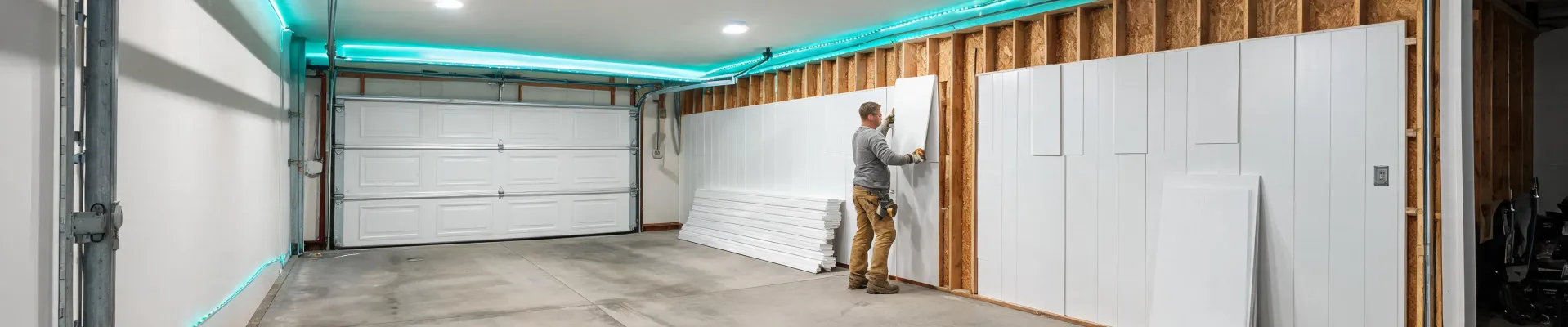
I measured the walls and got 2,480 square feet of surface. We chose the 10-foot Trusscore panels, which are 48 inches wide, so each panel covers 40 square feet. I did the division: 2,480 ÷ 40 = 62. I ordered 62.
That's the kind of clean math that costs money. The wall footprint wasn't a rectangle. There were window jambs, a column, a weird corner where a panel had to be angled, and door openings that produced offcuts too short for the next span. The crew installed everything correctly; the problem was my quantity was based on theoretical coverage, not real-world layout. Every estimator knows the rule: add a waste factor, usually 10%. I didn't apply it.
If I'd ordered 68 panels, the project would have moved without a hiccup. Instead, we ran short on a tight schedule.
The replacement order was simple: six panels at $41.80 each, plus $95 in expedited local freight. That's $345.80 in direct cost. But the real cost was bigger. The crew had to stop, tidy the site, and come back two days later. The office manager called twice with the same question: “Are we still opening on the first?” On a fixed-date project, that's not a rounding error. It's a credibility ding that lingers longer than the invoice.
The $95 Rush Fee That Practically Paid for Itself
I'll be honest about one thing: after I clicked submit on the rush order, I second-guessed it. What if a cheaper freight option had shown up a day later? What if the supplier's standard delivery would have been early anyway? I didn't relax until the driver called from the parking lot.
In hindsight, the expedited fee was the best money I spent that week. It wasn't just about speed. It was about a confirmed delivery window. The dental chair installation crew was scheduled for the following Monday. If the wall panels weren't ready, they'd move to another job and we'd lose that slot. That could have pushed the opening back by two weeks. Paying $95 to lock a date and eliminate ambiguity was a deal.
There's an old mindset in construction that buying “just enough” material is smart and avoiding extra freight is a point of pride. That thinking comes from a time with looser schedules and cheaper labor. Today, a stop-work gap costs far more than a 10% overage. When a supplier gives you a confirmed delivery date for a small fee, I now treat that fee as insurance, not waste. In an emergency, certainty is worth a lot more than the upgrade charge.
What I'd Tell a Procurement Person Today
First, put the waste factor in the purchase order. Don't keep it in your head. Our pre-order checklist now includes: net square footage ÷ panel coverage = theoretical panels; multiply by 1.10; round up; say the final number out loud to the distributor. “Sixty-nine panels, not 62, because of the 10% factor. Does that cover the cuts on this plan?”
Second, ask a better question. The question isn't “Is 62 panels enough?” The question is “Does this number account for openings, offcuts, and the actual layout?” A distributor can't know every window and column on my drawings. That's my side of the conversation.
Third, when the schedule is tight, buy the certainty. Trusscore pricing is generally straightforward, and the product itself wasn't the source of my stress. The unknown was delivery timing. A $95 confirmed delivery window is cheaper than any alternative I found on that job.
The dental office opened on time. The Trusscore panels look clean and bright, and the client didn't hold the hiccup against us. But I still think about that missing 10% every time a new estimate crosses my desk.
The extra panels on an order sheet aren't waste—they're the cost of not stopping work.
Prices in this story are from quotes we received in March and April 2026. Use them as a reference point, not a promise. Verify current Trusscore pricing and freight costs before you budget a project.