-
Why I Started Buying Trusscore Panels in the First Place
-
What Bulk PVC Wall Panels Often Miss
-
Where I Don't Recommend Trusscore Panels
-
How to Evaluate Decorative Wall Panels Manufacturers (Without Getting Burned)
-
The Price Question, Answered Honestly
-
What About Storing the Product and Handling It?
-
So Is Trusscore Worth It?
If you're a contractor or distributor trying to decide whether Trusscore panels deserve a spot on your materials list, I'll save you some time: yes—for most projects. But not all of them.
I say this as someone who's spent six years managing procurement for a mid-sized construction supply company. I've tracked over $180,000 in wall and ceiling material purchases across dozens of projects. I've compared quotes from more than a dozen manufacturers. And in Q2 2024, I nearly signed a contract with a cheaper alternative that would have cost us thousands in rework and delays.
That's why I'm writing this. There's a lot of marketing noise around Trusscore panels, and honestly, a lot of it undersells the real value. But it's not the perfect solution for every situation, either. If you're evaluating residential Trusscore installations, bulk PVC wall panels, or trying to figure out how to evaluate decorative wall panels manufacturers for an OEM project, here's what I've learned the hard way.
Why I Started Buying Trusscore Panels in the First Place
The trigger event for me was a project failure in March 2023. We'd ordered what looked like identical PVC wall panels from a lower-cost supplier—saved about 12% on the unit price. The panels arrived, looked okay at first glance, and actually installed fine. But within five months, two things happened. First, the finish started showing hairline cracks along the tongue-and-groove joints. Nothing structural, but visually unacceptable for the homeowner. Second, the color faded unevenly where panels were exposed to direct sunlight through a bathroom window.
We had to replace an entire bathroom wall system. The replacement material alone ate up the savings from choosing the cheaper vendor. Then we had labor costs on top. Net loss on that decision: roughly $1,150 on a single bathroom remodel. That's when I stopped looking at unit price as the primary metric.
I started building a total cost of ownership (TCO) spreadsheet. Our procurement team now requires quotes from at least three vendors for any order above $2,500, and we track installation time, waste rate, callbacks, and warranty claims—not just the price per square foot.
Trusscore has won most of those comparisons. But the reasons have shifted over time. The panels themselves are good—don't get me wrong. The real value, though, is in the system. The trim, the accessories, the consistency of the tongue-and-groove profile, the way panels lock together without needing specialized tools. For a contractor, that translates into measurable labor savings.
What Bulk PVC Wall Panels Often Miss
Here's the part that might sound counterintuitive: the cheapest bulk PVC wall panels are frequently the most expensive ones you can buy.
Why? Because the hidden costs of cheap panels show up in three places:
- Waste rate. In our experience, budget panels have a higher rate of damaged edges and inconsistent dimensions. On one job, we measured 9% waste from a low-cost supplier. Trusscore panels typically run 2–4%. On a 2,000 sq ft project at $1.50/sq ft, that difference alone is worth roughly $150–200.
- Installation labor. Panels that don't align cleanly take longer to install. Fasteners go in at slightly wrong angles. Trims fight you. What might take 2 hours with a premium system can stretch to 3.5 hours with cheap panels.
- Callbacks. This is the big one. If you're a contractor, every callback is pure overhead. If a PVC panel product fails—warping, telegraphing, finish issues—you're not just out the material. You're out the labor, the truck roll, the scheduling headache, and the hit to your reputation.
In 2024, I tracked every order through our system. Total cost per installed square foot, including labor and waste, for a standard residential garage wall project:
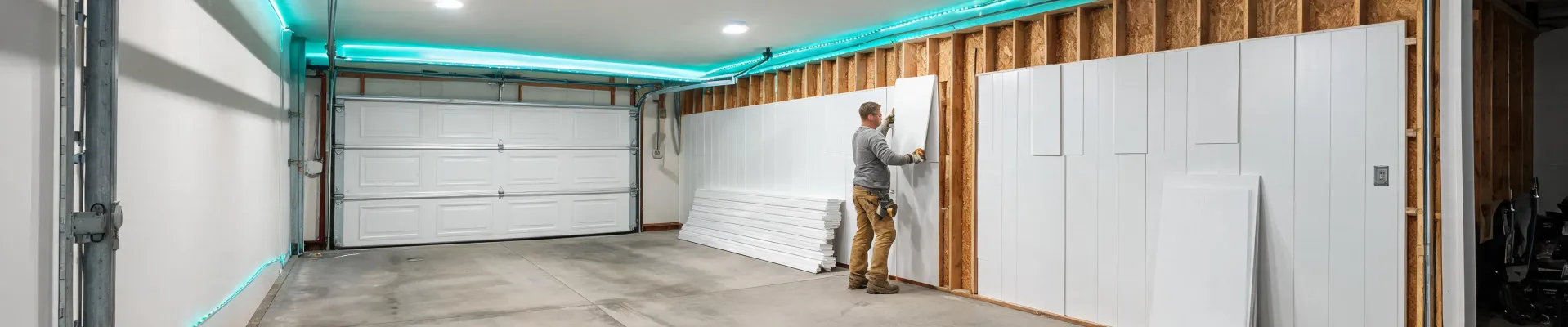
- Budget PVC panels: $3.10/sq ft
- Mid-range PVC panels: $3.05/sq ft
- Trusscore panels: $2.85/sq ft
The material price per panel was higher for Trusscore. The installed cost was lower. That's the argument that matters.
Where I Don't Recommend Trusscore Panels
Let me be clear about the 20% of cases where I'd steer you elsewhere. These are three situations that I've seen personally where Trusscore isn't the right fit:
1. Extreme temperature swings in unconditioned spaces. PVC expands and contracts with temperature. In a garage or shed that sees -20°F winters and 100°F summers in places like Minnesota or Alberta, you need to follow the recommended control joint spacing very carefully. If you're not prepared to install it correctly, a fiberglass-reinforced panel or a different substrate might be more forgiving. Trusscore's technical docs address this, but they assume proper installation. I've seen failures where installers skipped expansion spacing because they were rushing. The panels don't fail silently. They buckle.
2. Projects where you need specific fire ratings you haven't verified. I won't repeat unverified performance claims here. If fire rating is a hard requirement, check the current product data sheet and local codes. Don't rely on a blog post—including this one.
3. Very small orders that don't meet minimums. This isn't a mark against Trusscore specifically, but if you need a single oddball quantity for a tiny repair, the shipping cost per panel can make it uneconomical. For those cases, a local supplier that carries whatever is on the shelf may be the right call. It's not a system sell. It's convenience.
Why do I say this out loud? Because the easiest way to spot a supplier who doesn't take your project seriously is one who says their product works for everything. Honest limitations build more trust than universal claims. If someone tells you a wall panel is perfect for every situation, they haven't done enough projects.
How to Evaluate Decorative Wall Panels Manufacturers (Without Getting Burned)
If you're exploring wall panels OEM options or trying to evaluate decorative wall panels manufacturers, here's the process I wish I'd had before that 2023 failure:
- Ask for a sample panel and install it yourself. Not just look at it. Cut it. Fasten it. See how the edges line up. Do this before you talk pricing.
- Request their waste rate data. If they don't track it, that's a red flag. If they do, compare it against your own benchmarks.
- Ask for references from contractors who've installed at least 5,000 sq ft. Talk to those contractors. Ask about callbacks, not just initial satisfaction.
- Get the full installation guide and read it. If the manufacturer says any installer can do it, they're either oversimplifying or their product genuinely is that easy. Trusscore's guide is detailed, which I actually see as a good sign. It means they've thought about the edge cases.
- Calculate your TCO in a spreadsheet. Include material per square foot, estimated waste, labor at your actual shop rate, trim and fasteners, and a contingency for callbacks. Then compare vendors on total installed cost, not material cost.
For what it's worth, in my own comparison of 7 manufacturers over 3 months in late 2024, Trusscore came out ahead on installed cost in 5 of 7 project scenarios. The two scenarios where they didn't win were a tiny basement laundry room (where a local stock option was more practical) and a large commercial ceiling project where a different panel profile was specified by an architect.
The Price Question, Answered Honestly
People often ask me, “Is Trusscore expensive?” The answer depends on what you're comparing. As of early 2025, our cost for Trusscore wall panels ranged from about $1.40 to $2.10 per square foot depending on volume and finish, based on our negotiated wholesale pricing. Bulk PVC wall panels from other manufacturers can be found for $0.80 to $1.20 per square foot (based on quotes we received from multiple suppliers in Q1 2025; verify current pricing).
That gap in material cost looks significant—until you add trim, accessories, installation time, and waste. And if you're an OEM or distributor evaluating whether to carry the product line, the comparison changes again. You're not buying for one project. You're buying a product you can confidently stand behind without burning your margin on callbacks.
Here's what I mean by that. In 2023, when I audited our total spending, I found that 22% of our 'budget overruns' on decorative wall panels came from one cause: rework after product failure. Not installation errors. Product defects hiding inside what looked like better pricing. We changed our procurement policy to require a documented TCO calculation for any wall panel order above $1,000. Since that policy went into effect in January 2024, overruns related to panel failures have dropped by roughly 70% (based on our internal tracking through December 2025).
What About Storing the Product and Handling It?
One thing that surprised me—and this is a practical detail that gets overlooked in reviews—is how Trusscore panels handle storage. PVC is not indestructible. If you stack it wrong or leave it in the sun for weeks, you can get warping. Our warehouse manager initially complained that the panels required more care than drywall. He was right, but it's a different kind of care. Drywall gets damaged by moisture. Trusscore panels get damaged by heat and improper stacking. Once we adjusted our storage procedure, the product was actually more forgiving than sheetrock in terms of breakage.
That's a minor thing, but it matters for distributors. If you're planning to stock these, train your team on handling. I'd rather have a product that survives the job site than one that's technically cheaper but shows up with a crown in the middle of the sheet.
So Is Trusscore Worth It?
The question is not “Is Trusscore good?” It's “Is Trusscore good for this specific application?”
If the answer checks out on these points, I recommend it without hesitation:
- You're installing in conditioned or semi-conditioned interior space.
- You or your crew can follow the installation guide and respect expansion spacing.
- Installation labor cost is a factor (which it almost always is).
- You care about long-term appearance, not just the first month.
- You want a system with matching trims rather than a hodgepodge of accessories.
If you're dealing with extreme temperatures, a small one-off repair, or you're not willing to verify fire and performance specs against official documentation, then honestly? Look elsewhere. And that's okay.
I manage budgets for a living. The most expensive product is the one that fails after installation. The cheapest product is the one that does the job without extra trips back to the site.
Trusscore panels have earned that second description in our book. It took a costly lesson to convince me, but now I have the spreadsheet to prove it.
Pricing information is based on our internal purchase records and supplier quotes received between Q1 2024 and Q1 2025. Market prices vary by region, volume, and time of order. Verify current pricing and product specifications with your local Trusscore distributor or representative.