In my role coordinating material orders for a commercial construction firm, I don't usually get to compare wall systems in some calm, theoretical way. It's more often 2 p.m., the general contractor just told us the schedule slipped, and someone's standing in the trailer asking, "So what are we putting on these walls?"
Before you say "it depends" — I know. Everything in construction depends. But when the question is Trusscore panels versus drywall, tile, or FRP, and you have a hard deadline plus a budget you have to defend to a client, the comparison changes. People typically compare wall materials on unit cost and looks. That misses what actually sinks projects: installed cost, installation time, compliance paperwork, and supply certainty.
I've coordinated 40+ rush material orders in the last four years, including some genuinely cursed timelines. Here's how I actually compare wall systems when the deadline won't move.
Dimension 1: Trusscore wall panels cost vs. the cost of everything installed
It's tempting to think you can just compare material unit prices and call it a day. You can't. Identical-looking specs from different materials produce wildly different final costs.
Let's put some rough numbers on the table (national ranges, as of Q1 2026 — verify for your region):
- Drywall: About $0.50–$0.70 per square foot for the board. Installed — with taping, mudding, sanding, priming, and basic paint — it's more like $3.00–$5.50 per square foot.
- Ceramic tile: $5.00–$15.00 per square foot installed. The tile itself can be $1.50–$8.00/sq ft; the substrate prep and setting labor is where it gets expensive.
- FRP: $2.50–$4.50 per square foot for material, and it's usually installed over an existing drywall substrate. So you're paying for the drywall in the wall anyway.
- Trusscore: Based on quotes I've seen, material cost lands roughly in the $2.50–$4.00 per square foot range depending on panel line and volume (I don't have hard data on national averages — verify current pricing with a distributor before you budget).
Here's what most people don't realize: Trusscore panels are interlocking and mechanically fastened. So the installed cost sits close to the material cost. There's no taping, no mudding, no drying time, no separate paint crew. Plus, the panels can go over existing walls or studs, which skips the demolition and re-framing line item.
The counterintuitive conclusion: the material you assume is the budget option — drywall — frequently costs more than Trusscore by the time it's a finished wall. Not because drywall is expensive, but because it consumes labor across multiple trade visits. I wish I had tracked per-project labor costs more carefully over the years (note to self: actually build that spreadsheet this year). What I can say anecdotally is that switching from painted drywall to Trusscore on our wash-down projects consistently reduced the number of trade callbacks. And every callback costs you days.
Dimension 2: The timeline reality check
Now the dimension that matters most when you're on the clock: how many days until the space is usable.
A typical drywall timeline for one commercial room:
- Day 1: hang the board
- Day 2: tape and first coat of mud
- Day 3: second coat
- Day 4: sand and spot coat
- Day 5: prime and first coat of paint
- Day 6: final paint
That assumes no hiccups and exactly-on-time availability from three different trades. If the taper's running behind on another job, the whole chain shifts. Tile is worse in the drying dimension — setting, grouting, curing. I've seen tile kill a five-day turnaround before the tile even showed up (the order came in two lots and the second lot was backordered; the schedule died right there).
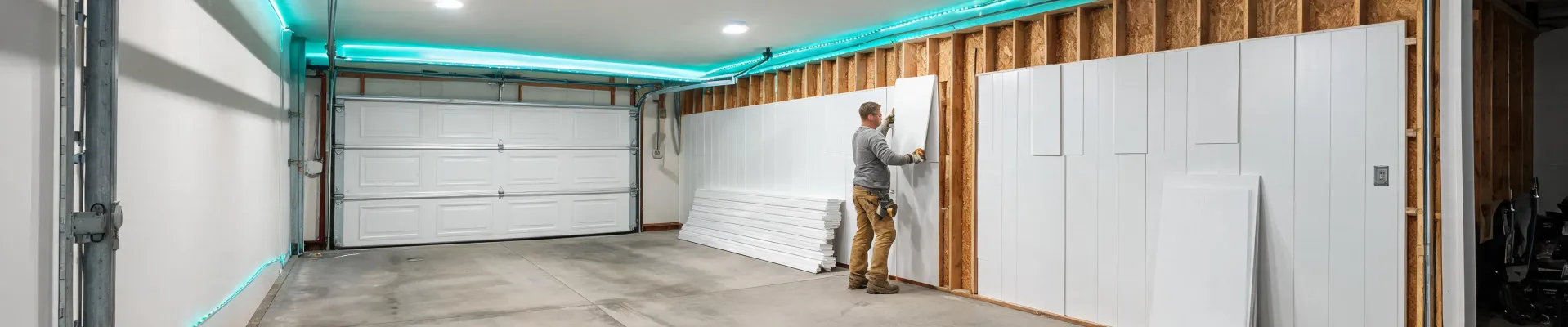
Trusscore's install story is different. Panels cut with standard wood tools, then adhered and mechanically fastened. No wet trades. A two-person crew that knows the system can cover a few hundred square feet in a day. There's no curing time — the space is usable essentially as soon as the last panel and trim are installed. I've also used Trusscore ceiling panels in the same rooms, which is a nice way to get one product and one install crew across the whole wash-down envelope.
In March 2024, a client called at 9 a.m. with a health inspection 72 hours out. The kitchen prep room was 600 square feet, and the walls had been absorbing food-service abuse for years. Normal turnaround for that scope: three weeks. We sourced Trusscore panels from a distributor in Jersey that had inventory, paid $400 extra in rush freight on top of the base material cost, and a crew installed across the weekend. The space passed inspection Tuesday morning. The client's alternative was failing the inspection and winding through an eight-week corrective process. That's when I started framing material choices around time certainty instead of unit price.
Dimension 3: Decorative wall panels compliance requirements
The thing I hear most from the specifiers I work with: compliance documentation is a nightmare. It's also the thing that quietly stalls a project when it's missing. Glossy samples don't matter at the inspection table.
Here's the compliance list I send to any decorative wall panels manufacturer or supplier when we're evaluating a product:
- Flame spread / smoke developed: Ask for the ASTM E84 or UL 723 classification. For most commercial corridors and exit paths, you're looking for a Class A rating — flame spread index of 25 or less, smoke-developed index of 450 or less.
- Room corner testing: For certain occupancies, the building code requires NFPA 286 (Room Corner Test) rather than just the surface-burning classification. Different standards, different outcomes. Verify which one your project's occupancy needs.
- Emissions: If the project is pursuing LEED or similar, ask about low-VOC or CDPH Standard Method (CA 01350) testing for interior finish materials.
- Moisture and impact data: For kitchens, washrooms, and food prep, get the manufacturer's written statements on water resistance and impact performance. The datasheet, not the sales one-liner.
Trust me on this one: the paperwork is as important as the panels. We didn't have a formal submittal-request process for compliance docs for years — it cost us when an inspector flagged a missing Class A fire classification in 2023 and the GC was standing there waiting while I dug through inbox history (not my proudest moment). I finally created a compliance checklist and it goes into every purchase order email now.
On Trusscore specifically: the company publishes specs and is generally quick to send compliance documentation when asked. That's part of its spec-transparency positioning, and honestly it's part of why I keep it in mind for deadline-driven work. But don't take my word on whether a product meets your code requirements. Send your exact compliance requirements to the manufacturer and get their confirmation in writing before you order.
Dimension 4: Distribution reality — the hidden supply chain risk
Here's a dimension nobody puts in the comparison until they've been burned: can you actually get the physical material when you need it?
Drywall is everywhere. You can get it delivered across town in hours. Tile is widely available at local supply yards, assuming you don't need a specific matching lot shipped from across the country.
Large-format PVC panels are less of a commodity. When you're looking for a PVC wall panels distributor, you'll find two types:
Type 1: Regional stockers. They warehouse inventory and can get product on a truck quickly. This is the kind of vendor you want when a schedule slips.
Type 2: Factory drop-shippers. Their pricing is often a bit better. The lead time is not. Your project timeline now depends on a factory production queue across the border. (This was back in late 2023 when a distributor quoted us "in stock" and it turned out to mean "available at the factory, ten-day lead." In my defense, in stock should mean in stock.)
Here's something vendors won't tell you: the first quote is rarely aligned with the delivery date that actually matters. You have to ask specifically — is the physical product sitting in your regional warehouse, and can you confirm a delivery window rather than a ship date? When I'm triaging a rush order, I now treat a confirmed delivery window as a requirement, not a nice-to-have. Paying a bit more to a distributor with confirmed local inventory is worth it. The difference gets eaten by one day of one crew standing around.
So which do you spec?
I'm not going to tell you Trusscore is always the answer, because always is a word that gets people into trouble in construction. Here's how I frame the decision:
Choose Trusscore when: The schedule is real — attorney-involved, penalty-clause real. When you want one crew to handle the finish without waiting on three trades. When the space will be washed down and needs to clean up fast. When you need published specs rather than "ask our rep." And when you might reconfigure the wall later, since the panels come off without a demolition crew.
Choose traditional materials when: The design genuinely calls for a plastered or tile aesthetic and the owner has the time and budget for it. When you have scheduling buffer (if you legitimately have six weeks, drywall is totally fine). When the wall assembly itself needs to be a fire-resistance-rated assembly — Trusscore is a finish product, not a structural or fire-rated assembly, and knowing the difference is on you as the specifier.
Bottom line: Trusscore is a time-certainty play. It costs what it costs, it installs in hours instead of days, and the documentation is where it should be. That's why I've selected it on deadline-driven projects, and why I'll pay for guaranteed delivery windows.
Rush fees buy certainty, not just speed. An uncertain cheap option is way more risky than a certain slightly-expensive option. I've paid $400 extra in rush freight because the alternative was missing an inspection deadline that would have cost the client $15,000. I'd make that choice again every time. When you're deciding between two wall systems and one can deliver on Tuesday and the other can maybe deliver eventually — that's the whole answer right there.