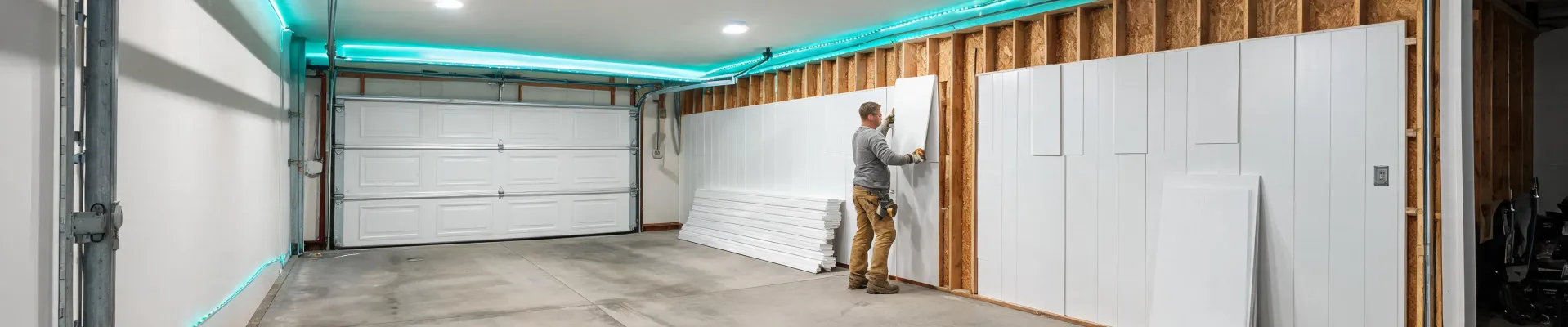
When I first sent out a request for quotes on a commercial wall covering package, the panel option looked like an easy pass. The commercial wallpaper distributor we'd used for years quoted less than half the material cost per square foot. I almost wrote off the entire panel category — Trusscore included.
Three years and a fairly thick stack of invoices later, I realized I'd been comparing the wrong numbers the whole time.
The Surface Problem: The Quote Is Not the Cost
I manage procurement for a mid-size commercial interiors company. My team handles wall finishes for office renovations, retail refreshes, and light industrial spaces. Early on, I treated wall coverings the way I treated desk chairs — find a decent product, get three bids, pick the one that fits the plan.
The bids were the problem. Not because anyone was dishonest. Most of the vendors I dealt with were genuinely trying to help. The problem is that what appears on a material quote and what actually lands on the invoice are two very different numbers.
Take labor. I'm not an installation contractor, so I can't speak to every field condition. What I can tell you from the procurement side is this: labor is where wall covering budgets go to die. Wallpaper installations can involve surface prep, seam matching, drying time, and a skilled hanger whose availability alone can drive the schedule. The quote depends heavily on assumptions about wall condition — assumptions that are almost always optimistic.
With wall panels, the labor equation tends to be more direct: more square feet covered per panel, fewer specialty trades, less mess. But you'd never see that from material quotes alone. The only way to get an honest installed number is to ask for a fully loaded quote — materials, prep, installation, disposal, and a schedule.
I'm not saying panels are inherently better than wallpaper. I'm saying the gap between “material quote” and “total installed invoice” was significantly wider for some products than for others. And that gap is where my budgets kept getting into trouble.
The Deeper Problem: Specification Ambiguity
Here's what took me the longest to understand: the biggest cost driver wasn't the product at all. It was the quality of the specification.
Early on, our wallpaper spec was short. “Wall surface: 3,400 sq ft. Install per manufacturer instructions.” That single sentence cost us two change orders and almost a week of schedule delay on one project. The installer read “per manufacturer instructions” his way; the project manager read it hers; and the difference landed in my budget.
Now our spec template includes the substrate type, corner detailing, trim schedule, and an explicit line tying the installation back to the manufacturer's published instructions. It took about an hour to build. It has saved days per project.
Wall panels are exactly the same if you let them be. Writing “Trusscore panels” on a line without referencing product data — panel dimensions, coverage rate, trim requirements, recommended substrate conditions — is an invitation for contractors to price in risk. And in my experience, contractors price in a lot of risk when they sense ambiguity.
Per FTC guidelines (ftc.gov), performance claims in marketing need substantiation. I'd argue a spec document should meet the same bar. When a manufacturer says “impact resistant” or “moisture friendly,” I want to see the test method, not a slogan. That's not me being difficult. It's me protecting a budget.
The Cost That Never Makes It Into the Budget
Then there's the cost that doesn't appear in any initial quote: the replacement cycle.
A fresh wallpaper install looks fantastic on day one. I won't argue with that. But in high-traffic commercial spaces — corridors, meeting rooms, retail fronts — that fresh look has a shelf life. Repair costs and replacement costs are real line items, and most project budgets forget to include them.
After tracking more than 40 orders over four years in our procurement system, I found that most of our wall finish overruns were not about material price at all. They came from scope interpretation, change orders, and rework. One “cheap” option resulted in a $1,200 redo when seams lifted eleven months in. If I'd built the probability of that redo into the original comparison, the choice would have been obvious.
The clearest version of this lesson came in Q2 2024, when we ran two near-identical projects side by side. Same square footage. Similar occupancy type. One project specified wallpaper; the other specified Trusscore panels. The panel project carried a higher material line item. But it finished in three days with zero change orders. The wallpaper project took eight days, needed a second visit to address seams, and the space was partially unusable the following week while things dried. To be fair, that might be an anomaly — but anomalies have budget impact too.
Seeing those two invoices side by side finally flipped my mental model. Material cost is a small part of the story.
What We Changed: Specifying the Outcome, Not Just the Product
The fix didn't come from switching to premium products. It came from changing the question we ask vendors — from “What's your price per square foot?” to “What's the total installed cost over the period we actually plan to keep these walls?”
When I evaluate Trusscore panels now, I look at what the spec sheet actually tells me: panel dimensions, coverage rate, trim requirements, installation method, and the conditions the product is designed for. Most of that detail lives in the Trusscore wall panels specification guide. It answered in writing the questions I used to chase across three phone calls.
That efficiency matters, if you ask me. When I can go from first inquiry to installed quote with fewer emails and fewer follow-up questions, it shows up in the bid. Contractors don't pad bids when they clearly understand what they're bidding on.
Trusscore paneling is now a regular part of our renovation conversations. Not because it's the cheapest option — I've stopped looking for the cheapest option. Because the cost picture is predictable, and predictability is worth a premium in procurement.
A Note for Distributors
If you're a distributor, this story has a second angle. Your customers are running the same calculations I just described. If you're exploring a wall panels private label program, push the manufacturer to let their technical documentation carry through to your branded version. In my experience, brands that make quoting easy get specified, regardless of what name is on the box.
I don't believe every project should use panels instead of wallpaper. I do believe every project team should run the comparison on total installed cost, not material cost. That's where I went wrong — and correcting it didn't require a bigger budget.
It required a better question.