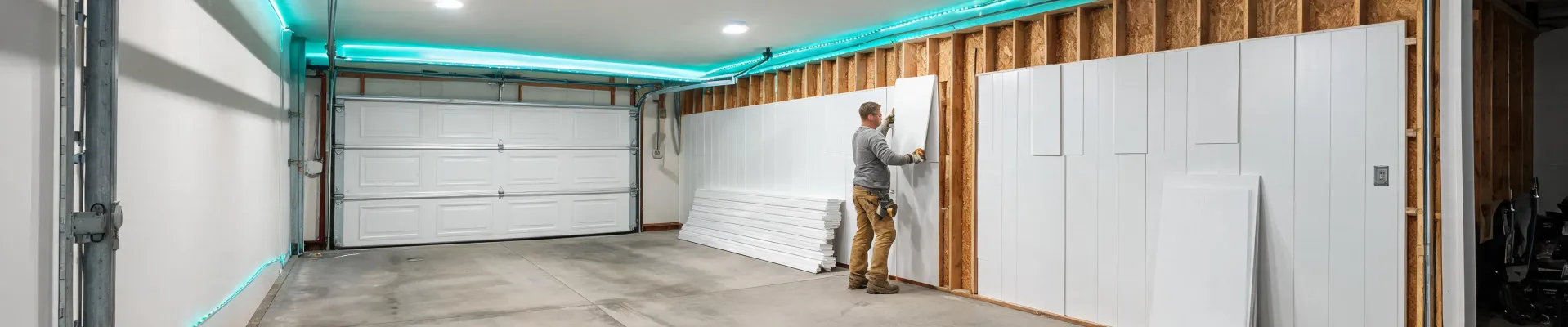
The short answer
If you need PVC wall or ceiling panels delivered in Canada inside three weeks, buy from a distributor that stocks a Trusscore program. Don't chase an OEM quote. Don't entertain private label.
Neither will clear your deadline, and the price difference you were chasing usually evaporates once you add tooling, freight, minimum order quantity, and the cost of your own time.
The inversion, though, is real. If you have 10,000+ sq ft, a spec you control, and 10–14 weeks, OEM is the better number. If you're moving full containers a year and you want your name on the carton, private label is where you eventually land — but that's a working-capital decision dressed up as a product decision.
So, roughly: stocked program under 3 weeks. OEM above 10,000 sq ft and 10+ weeks. Private label only at container volume, with cash you can park in inventory.
Where this comes from
I coordinate rush orders at a building materials distributor. Six years, 400+ rush jobs, most of them wall and ceiling systems for commercial interiors — clinics, car washes, restaurant back-of-house, food processing, a few garages.
In March 2024, a contractor called at 4pm on a Thursday needing 2,800 sq ft of panel and matching trim for a handover Monday morning. Normal lead time on the specified profile was three weeks. We had partial stock, found the balance at a sister branch 380 km away, and ate about $1,100 CAD in expedited freight to move it overnight. The contractor's alternative was pushing the client's walkthrough by two weeks, which would have delayed a holdback release on a $180,000 fit-out. We ate the freight.
That's the trade. Rush orders are rarely about unit price. They're about which failure mode you can absorb.
The three routes, and the deadline math
Stocked program (distributor or dealer)
Timeline: 2–10 business days if the profile is sitting on a shelf somewhere in the network.
What kills it: trim. Everybody remembers the panels and forgets the corners, base, and transition pieces. Trim is often a different SKU with a completely different stock position.
Practical move: send your takeoff with trim line items to two or three distributors and ask specifically what is physically on a shelf today, and where. Not lead time. On the shelf.
Decorative wall panels OEM
Timeline: 8–16 weeks door to door, assuming the tooling already exists.
What people get wrong: OEM doesn't automatically mean custom. In this category, most OEM orders run on existing extrusion dies with a custom color, length, or finish, plus your packaging. A genuinely new profile adds 6–10 weeks and four to low five figures in tooling before anyone extrudes anything.
Where it wins: repeat projects. If you'll spec the same panel across 20 jobs over two years, OEM pricing compounds. On a one-off, it doesn't.
Acoustic wall panels wholesale, then private label
Timeline: 10–20 weeks, plus production slot availability.
The catch: "acoustic" in a wholesale listing often means perforated or felt-faced decorative panel. Actual absorption performance needs a lab report. Ask which standard it was tested to — ASTM C423 for absorption, ASTM E1264 for ceiling product classification, and in Canada, CAN/ULC S102 or ASTM E84 for surface burning characteristics. If a supplier can't point you to a report with an accredited lab and a date on it, treat the number in the spec sheet as decoration.
In my first year I made the classic version of this mistake: assumed "OEM" on a spec sheet meant the panel was being made for me. It meant the supplier had an OEM pricing tier. Cost us a $600 redo on a trim profile that didn't match, plus a week of schedule.
OEM vs private label is the wrong framing
People think private label is just the cheaper version of OEM. Actually, they solve different problems.
OEM solves a product problem: your spec, your dimensions, your color, run on someone else's line.
Private label solves a capital and channel problem: your brand, your minimum, your inventory risk, your unsold pallets in a third-party warehouse in Mississauga.
The unit price on private label usually lands lower. The total cost almost never does at low volume, because you're now financing inventory, storage, damages, and slow-moving SKUs. That's the part that doesn't make it into the comparison sheet.
And here's something suppliers won't tell you: the first quoted MOQ is rarely the real MOQ. It's the MOQ that's convenient for them at that moment. If you can commit to a forecast instead of a single order, that number moves. I've watched MOQs drop by roughly a third on a second conversation with a signed 12-month forecast attached.
Trusscore pricing in Canada: what actually moves the number
I don't have hard data on national average pricing. Nobody publishes that in a way I'd trust, and quotes move with resin costs, freight, and how badly a distributor wants the account in a given quarter. What I can say from running quote comparisons is that most of the variance isn't in the panel.
As of early 2026, the pattern I see on Canadian quotes for PVC wall panel systems:
- Panel: roughly 60–75% of the material subtotal
- Trim and accessories: 15–30%, and this is where quotes diverge most
- Freight: fixed but brutal on small quantities — a single-pallet order to a remote site can run 8–15% of material cost
- Slatwall and specialty profiles: quoted separately, usually per sq ft, with their own minimums
Three things move a Trusscore quote more than anything else:
- Quantity breaks. Partial pallet → full pallet → multi-pallet is not a linear price curve.
- Color and finish. Stock white is stock white. Anything else carries a minimum.
- Who's asking. A contractor buying three times a year gets a different tier than a distributor buying monthly. That's not a conspiracy, it's just how price tiers work.
If you're budgeting against "trusscore pricing canada," get two quotes from different regions and compare the trim lines specifically. That's where the real delta hides.
The paperwork you need on either route
Whichever route you take, if your name ends up on the product or the marketing, the claims become yours.
Per FTC guidance (ftc.gov), advertising claims must be truthful, substantiated with evidence before you make them, and not misleading. Under the Green Guides (16 CFR Part 260), a "recyclable" claim should hold for at least 60% of consumers where the product is sold. That's US law, but Canadian buyers doing cross-border work run straight into it.
On the Canadian side, the Competition Act was amended in 2024 (Bill C-59) to tighten substantiation requirements around environmental claims, with a private right of action following. As of early 2026, "we use recycled content" without a documented basis is a real exposure, not a theoretical one.
So when you buy OEM or private label, ask for the file: lab reports with dates, resin or recycled-content documentation, and the right to reference them in your own materials. If a supplier won't hand that over, they've told you something useful.
When this advice doesn't apply
This whole assessment assumes a North American job site and a deadline measured in weeks, not days or years.
If the wall has to meet a specified hourly fire rating, none of the above substitutes for the tested assembly listing. You need the assembly, not the panel spec. Same story if you're specifying acoustic separation between rooms — a panel's absorption coefficient tells you almost nothing about transmission loss through the wall.
And if you're a distributor looking at private label purely to protect margin, price the carrying cost of inventory first. I've watched that math turn negative more than once, usually in year one, usually right after the first big shipment lands.
None of this is complicated. It's just rarely explained by anyone with an incentive to sell you the longer lead time.