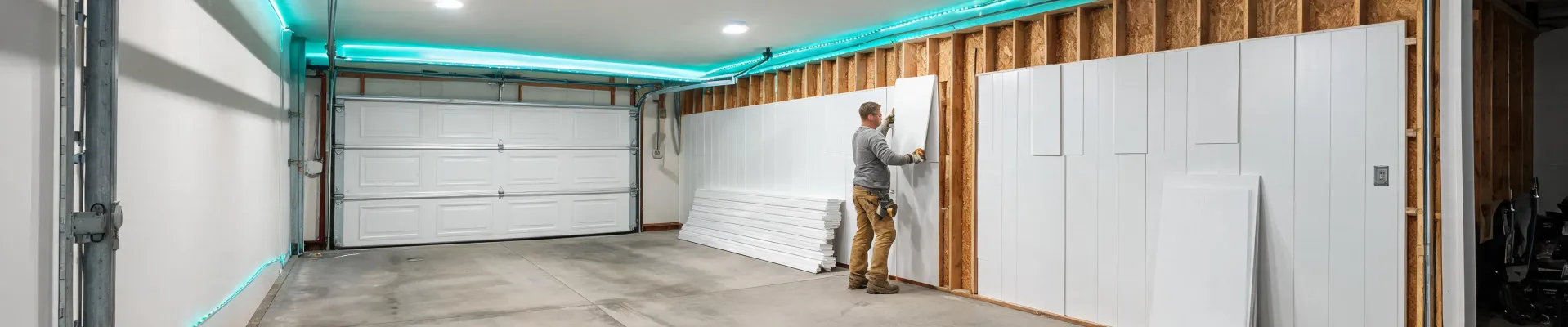
If you're staring at a spec sheet with Trusscore on one side and commercial wallpaper on the other, you're in good company. I've sat through this exact comparison more times than I can count—easily forty projects over the past seven years.
Quick background: I coordinate commercial renovation deliveries. A lot of what I handle is the kind of job that comes in on a Thursday with a Monday deadline. The tightest one was a restaurant wall replacement that had to be finished 36 hours before a health inspection. So when I compare wall systems, I'm not comparing brochures. I'm comparing what actually shows up on site, on time, without drama.
Here's how I break it down. Four dimensions. Each one directly compared. Then at the end, what I'd pick depending on your situation.
Dimension 1: Real Cost Per Square Foot
Trusscore panels list somewhere in the $2.50–$4.50 per square foot range for standard wall configurations (as of January 2025—verify current rates, pricing moves and varies by region and volume). Commercial wallpaper in bulk typically runs $0.50–$1.50 per square foot for the material alone.
That gap looks huge. Paper math says wallpaper wins by a mile.
Here's what most people don't realize: you're not buying material. You're buying surface prep, labor hours, and rework risk. Wallpaper needs a flat, dry, primed surface. If the wall isn't there yet, you're paying someone to get it there. Then you're paying to hang it, seam it, and wait for it to dry. A 2,000 sq ft commercial kitchen wall in my experience runs roughly $6,000–$9,000 installed with wallpaper and takes 4–6 working days. The same wall in Trusscore panels costs more in material but skips the prep stage entirely—installed price lands closer to $7,000–$10,000, and it's done in about 2 days.
The gap shrinks fast once labor enters the picture. This is the part that rarely shows up in a side-by-side spreadsheet.
Dimension 2: Install Speed—Where the Decision Usually Gets Made
Honestly, this is the dimension that decides ninety percent of the projects I touch.
Wallpaper is a finish trade. The wall has to be right before the roll goes up. Clean, level, sealed, dry. Then cutting, pasting, hanging, seaming. Add drying time between stages. Small jobs: 2–3 days. Anything meaningful: 4–6.
Panels work differently. They're modular. You place them, lock them, trim the edges with coordinating profiles. It's closer to assembly than application. No drying time. No seam paste.
If your project is deadline-bound—opening date, inspection, tenant move-in—this difference isn't marginal. It's the whole thing.
My rule of thumb: once a project drops below 5 days of runway and the wall area is over 1,500 sq ft, wallpaper gets risky. Not because it can't be done, but because there's no cushion left. Any hiccup—delivery delay, a wall that's not as flat as promised, humidity issues—becomes a real problem instead of a minor inconvenience.
Dimension 3: Acoustic Claims and Manufacturer Evaluation
If acoustic performance is part of why you're looking at wall panels, slow down here.
Most products labeled "acoustic" are controlling sound absorption, not sound isolation. Those are different things. Absorption changes how a room sounds inside—reverb, echo, perceived loudness. Isolation is about whether noise passes through the wall to the next room. I've watched project teams buy absorption panels expecting isolation performance and end up disappointed.
When I evaluate acoustic panel manufacturers, I look for three things:
- Which standard the test report cites—ASTM C423 for absorption, ASTM E90 for transmission. If they can't name the standard, they don't have real data.
- How the mounting method affects the rating—a panel's performance changes based on how it's installed. The datasheet number assumes a specific install, and if yours is different, so is the result.
- Whether they'll run an estimate for your actual wall assembly—manufacturers who offer this tend to be the ones worth working with. The ones who just email a product PDF and wish you luck are usually a step behind.
Wallpaper basically doesn't compete here. Standard wallpaper contributes almost nothing to a designed acoustic outcome. Some specialty backings change things slightly, but not in a way you can spec and predict.
Dimension 4: Durability and What You'll Actually Spend Over Time
Commercial walls get abused. Carts, deliveries, cleaning equipment. Wallpaper's failure modes are visible and annoying: bubbling, peeling seams, scuffs that can't be spot-repaired without a patch that never quite matches.
Panels generally hold up better in high-traffic environments. Impact damage tends to be local, and individual panels can be swapped without redoing the wall.
I had a restaurant chain client who ran wallpaper in three kitchens for about three years. By then they'd spent more on patching and partial re-hangs than the original material premium for panels would have cost. They switched. Not because panels are magic—they're not—but because the maintenance math flipped.
That said: if you're running a low-traffic, dry, well-maintained space and you've got plenty of runway, wallpaper can absolutely be the right call. The mistake is treating the material savings as the total savings.
So Which One?
No universal answer. Depends on the situation.
Wallpaper makes sense when: budget pressure is real, the space is low-traffic, walls are already flat and dry, and the timeline has breathing room. Also if the space is likely to be renovated again within 3–5 years.
Panels make sense when: the deadline is tight, the wall base is imperfect, the space is wet or heavily trafficked, or you want to reduce the number of times maintenance has to come back.
One more thing—looking back at a call I got wrong, I should have paid attention to supplier reliability instead of saving $1,800 on paper. A wallpaper vendor's delivery slipped by two days, the install crew sat idle, and the rush fees plus emergency re-sourcing ate the entire "savings" plus a bit more. Since then I've had a rule: on projects under seven days, delivery reliability outranks price. Every time.
And on bulk wallpaper supplier negotiations: don't judge a supplier by their first quote. The real pricing conversation usually opens on the second or third order, once you've proven you're an easy customer to work with. First quotes are often defensive.
Whichever way you go, ask suppliers these four things before you commit: the specific test standard for any performance claim, the delivery slip penalty terms, the tiered pricing for bulk orders, and whether installation support is included. If any of those four comes back vague, that's information too.
(Should mention: the price ranges above are based on public listings and industry conversations as of January 2025. Rates move. Confirm with current quotes before you budget.)