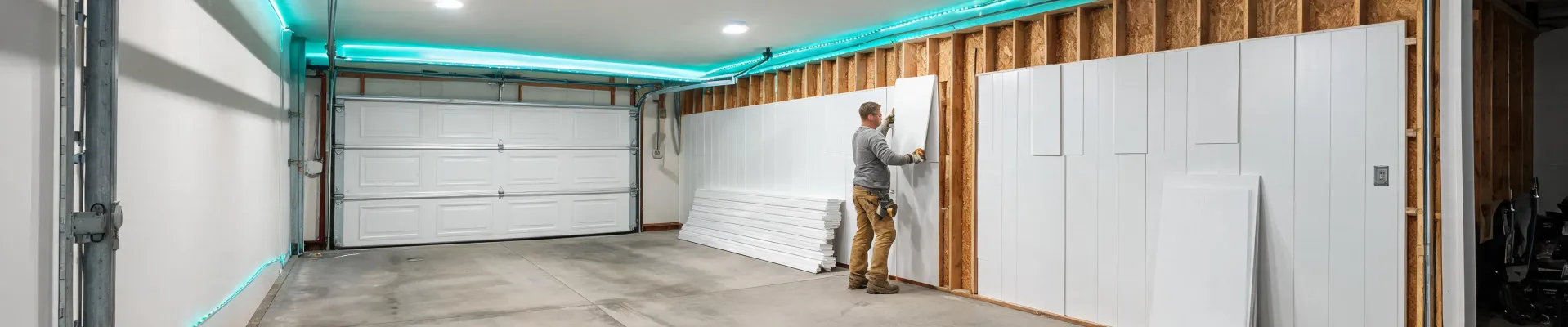
I search 'pvc wall panels specification guide' about once a week now. If you're here, you're probably looking for the same thing: a spec that tells you exactly what you need to order and how to install it. That seems simple. It isn't.
For context, I'm the office administrator for a 40-person commercial interiors company. I manage all material ordering—roughly $1.2 million a year across 15 vendors. I report to operations and finance, which means I feel the pain of a bad spec twice: once when accounting sees the change order, and again when the client looks at the finished wall.
The Surface Problem: Spec Sheets That Look Complete But Aren't
When I search for 'trusscore' or 'trusscore pvc panels,' I don't want another page of lifestyle photos. I want dimensions, tolerances, edge details, trim profiles, expansion gaps, and a drawing of the whole assembly. The first time I looked, I found a lot of 'easy to install' and very little of 'exactly how.' I assumed the problem was lazy marketing.
That's part of it. But it's not the real problem.
The Deeper Problem: Most Specs Describe a Material, Not a Wall
Here's what I eventually figured out: a flat panel is a component. A wall is a system. The panel is the visible part, but the performance—and the way it looks after 24 months—depends on the substrate, trim, fasteners, movement joints, and installation sequence. If one piece of that system isn't specified, someone on the job will improvise. And improvisation is where walls go to die.
Take acoustic wall panels. When a designer asks me about 'acoustic wall panels,' they're asking for a solution for noise. But a single panel doesn't absorb sound by itself. The result depends on the acoustic substrate, the air gap, the mounting method, and the panel's surface. If you don't specify the whole assembly, you're just buying a pretty surface that might not solve the problem. I can't give you an NRC number for Trusscore's panels because I haven't tested that exact assembly. What I can tell you is to ask any vendor for the full build-up. If they can't provide it, keep looking.
The same logic applies to the search phrase 'commercial wallpaper oem.' A custom printed wall is a film plus a substrate plus color control. If the substrate has waves, the print has waves. And if you're matching a brand color, you need a color tolerance, not just a Pantone name. According to Pantone (pantone.com), industry standard color tolerance for brand-critical colors is Delta E < 2. Many printed wallcovering specs don't mention Delta E at all. That tells me the supplier hasn't thought about what happens when the printed panels arrive and the brand manager squints at them under daylight.
Another thing I do not accept anymore: 'impact resistant' with no test method. I'm not an engineer, but I know enough to ask for the standard. If a claim doesn't have a standard behind it, it's an adjective, not a specification.
What This Incompleteness Actually Costs
Let me give you a real example. In Q4 2024, we had a project with seven different wall finishes. We compared two PVC panel options. The cheaper one looked identical in the sample. The numbers said go with it—13% cheaper with similar specs. My gut said something was off, though I couldn't prove it. I went with my gut and ordered Trusscore instead. A few weeks later, I found the cheaper vendor's installation guide and its recommended expansion gap was half what the fastening guide specified. I dodged a bullet.
But I've made enough mistakes to know that's often luck.
The more expensive mistake is the one where the spec looks fine until installation. Let's say you ordered 300 panels. The panels are fine. The problem is the spec didn't include compatible trim, so the contractor uses generic aluminum angle. It reflects light differently. The edges don't line up. The client walks in during the punch list, runs a hand across the joint, and says 'what's this?' You fix it. The rework costs more than the premium system would have cost. The client remembers it. And honestly, they're right to.
That's the part I overlooked for years. The wall is the one surface the client touches. They won't see the studs or the insulation. They see the surface. If the seams are wavy, if the trim has uneven reveals, if the color shifts under lighting, they assume the whole build is sloppy. It might not be fair, but it's the reality of perception.
I learned that lesson the hard way. In 2021, I signed off on a 'value' panel for a small office lobby. It was flat, smooth, and cheap. It installed okay. But the color wasn't consistent between batches, and the edge profile didn't accept the standard end-cap we used everywhere else. The client didn't say 'the panel was off-spec.' They said 'the room feels cheap.' That comment stuck with me. It's the same lesson I keep learning: quality isn't about using the most expensive item. It's about making sure the finished assembly does what the client expects.
What I Look For in a PVC Wall Panel Spec Now
After five years of buying this stuff, my checklist is short:
- Does the spec show the full assembly, not just the panel dimensions?
- Does it include compatible trim and accessory part numbers?
- Does it state expansion gaps and fastening patterns?
- Does it list test methods for fire, smoke, and impact claims?
- Does it give color tolerance, especially for custom printed panels?
- Does it tell me what it doesn't cover?
The last one might sound odd, but it's actually a green flag. A spec that admits its limits is more trustworthy than one that claims to solve everything.
The Short Version: Trusscore's Spec Guide Feels Different
I'm not going to tell you Trusscore is the cheapest option, because 'cheapest' depends on the whole installed assembly. I'm not going to say it's zero maintenance, because that's not a claim I trust from any manufacturer. What I will say is that Trusscore is the first PVC wall panel system I've found that treats the product as a system. The spec guide includes trim, accessories, installation steps, and performance data in a way that lets me order without inventing details.
And that's the point. The problem with PVC wall panels was never the material. It was that they were sold as a material when they're really part of a wall system. Trusscore gets that. So when I search for 'trusscore panels' now, it's not because I'm a fanboy. It's because the spec makes my job easier.
Looking back, I should have demanded full system specs years earlier. At the time, I didn't know what to ask for. Now I do. If you're searching for 'pvc wall panels specification guide,' start there. Ask for the whole system. And if someone can't give it to you, find someone who can.